Tuesday, September 14, 2010

GF FROM P.F. CHANG'S, Eat-in or Take-out

P.F. Chang's
What would Brooklyn be without its ubiquitous Chinese restaurants?  It just wouldn’t be the same. Once it seemed most of our Chinese immigrants came from Guangdong Province, so our Chinese food was generally Cantonese. It was always filling, sweet and spicy, and served with hot, hot oolong tea. There was egg drop soup or wonton, fried egg rolls, barbecued spare ribs, lobster Cantonese, chicken chow mein with crispy noodles, and white and pork-fried rice. 
Dinner was generally followed by a small bowl of lychee's or kumquats in syrup, a diminutive almond cookie, more tea, and a fortune cookie. It was all wonderful and memorable. Unfortunately, if you have Celiac disease, eating out in a Chinese restaurant is a thing of the past. Virtually everything Chinese is made with soy sauce, which has wheat in it. There are wheat-free soys or tamari but, with one exception, their use is not an adaption that is commonly made by restaurants. The one exception is the American restaurant chain: P.F. Chang’s.
P.F. Chang’s is the only Chinese restaurant that I know of that offers a gluten-free menu.  The restaurant is clean and nicely decorated. The food is fresh, delicately seasoned, fragrant, and presented beautifully. The wait-staff is just about as good as you can get. And -okay this is my own hang-up maybe - the restrooms are clean. Yesterday, in  recognition of Celiac Awareness Day, the company announced an expanded gluten-free menu of twenty-nine choices and a new gluten-free dessert, Triple Chocolate Mousse Mini Dessert. Link to their site for locations, menu, gluten-free recipes, and a Warrior Card. No kidding! Sign up for the Warrior Card for 10% off all year at P.F. Chang's. Such a deal! 


Actual product ingredients may differ from than that which is shown or suggested on this blog. Please remember that you should not rely solely on the information presented here or anywhere online and that you always read labels, warnings, and directions before purchasing and consuming a product. 

HOW TO MAKE LEBANESE COFFEE, Al-Qahwa

ho345141wg713_250
Photograph: Tulumba.com


Lebanese coffee is served demitasse style in cups such as the one pictured here.
ho380513ks717_1251


Photograph: Tulumba.com


Dark-roasted coffee beans are finely ground in beautiful etched-brass coffee-grinders.
ho185933wn119_2501
Photograph:  Tulumba.com


Lebanese coffee is prepared in a narrow, long-handled brass pot, called a rakweh.


Lebanese Coffee, Al- Qahway, is generally served sweet (mazbuhtah), moderately sweet (wahsat), very sweet(helwa) or, at funerals, bitter (murrrah). The difference between traditional Turkish coffee and traditional Lebanese coffee is that the Lebanese is flavored with cardamom. If you prefer to have traditional Turkish coffee, follow the recipe, but leave out the cardamom.

The equipment used to prepare and serve Lebanese coffee can be purchased on-line at Tulumba.com, in local Mediterranean groceries, and at some department stores. You will find the coffee pot in product listings as "Turkish Coffee Pot."  These pots come in several sizes from small enough to prepare coffee for just two people or large enough to prepare coffee for up to twelve people. Traditionally the pots were made of brass but you will also find them for sale in stainless steel, which may be easier to care for but which I find prosaic and unromantic.  I prefer old brass pots.

You must purchase dark-roasted coffee ground for Turkish coffee, which is so fine it's like a powder. I use Peet's Italian Roast or Espresso Forté. The Espresso Forté is the stronger of the two. Only purchase as much coffee as you will use the same day.   It's best when it's fresh.

This recipe is for two servings. Just multiply the ingredients to prepare the coffee for more people.  This is an easy prep process.  Don't be intimidated.

Recipe

The ingredients:
For two demitasse cups, medium sweet:
  • water
  • 2 tablespoons dark-roasted coffee, ground for Turkish Coffee
  • 2 teaspoons organic sugar
  • 2 cardamom pods


The preparation:
Pour two demitasse cupfuls of water into the rakweh. Bring the water to a boil, remove from heat, and add the coffee and sugar. Put the pot back on the heat.  The coffee will foam up.  Remove from heat and let the foam subside.  Add the cardamom pods. Put the pot back on the heat and let it foam again.  Remove from heat.  Let the foam subside.  Do the process once more. Pour into cups.  Drink hot, hot, hot.


Actual product ingredients may differ from than that which is shown or suggested on this blog. Please remember that you should not rely solely on the information presented here or anywhere online and that you always read labels, warnings, and directions before purchasing and consuming a product. 

Monday, September 13, 2010

NATIONAL CELIAC AWARENESS DAY, this may save your life ...

Samuel Jones Gee, born September 13, 1839.
Samuel Jones Gee (13 September 1839 – 3 August 1911) was an English physician. In 1888, Gee published the first complete modern description of the clinical picture of coeliac disease [Celiac Disease], and theorised on the importance of diet in its control. His contribution led to the eponym Gee's disease. Gee is also credited with the first English-language description of cyclic vomiting syndromeMORE[Wikipedia]
September 13, Dr. Samuel Gee's birthday, is the date of U.S. National Celiac Awareness Day (S. Res. 563, 2006). Gee was the first to find the link between celiac/sprue and diet.


Pressed for time, I apologize for writing this from a mostly American perspective. Celiac disease is a universal health issue, not restricted to any specific peoples or place.  In this country and elsewhere it goes largely unrecognized and undiagnosed with devastating results. It is thought that 95% of the people who have Celiac disease have a genetic disposition to it. The thing is that most of us don't have parents who were ever tested or diagnosed.  My mother, who battled cancer from the age of thirty-six on, probably had it.  She had radiation treatments while pregnant with me and died painfully at seventy-six of colon and breast cancer. Celiac disease may have been the primary cause of her multiple cancers. We'll never know. I have it. My son was tested after my diagnosis. He tested negative.


The percentages are small, but the numbers are significant: people with conditions such as lupus, cancer, autoimmune disease, osteoporosis, diabetes, irritable bowel syndrome, attention deficit, autism ... and the list goes on and on ... actually have Celiac disease as the primary condition from which the other results.
[Undiagnosed and unaddressed allergy or sensitivity to wheat, barley, rye, kamut, and spelt] is the root cause of many cancers, autoimmune diseases, neurological diseases, chronic pain syndromes, psychiatric and other brain disorders, premature death. There is also a clear causal connection with some cases of osteoporosis, epilepsy, attention deficit disorders and learning disorders, infertility, miscarriage, premature births, chronic liver disease, and short stature." Dangerous Grains
In my case, hypersensitivity pneumonitis and lung fibrosis were exacerbated by Celiac Disease and, when I went on a wheat-and-gluten-free diet, my condition improved enough that I was pulled off the lung transplant list. I had a sixteen percent increase in diffusion of gases, oxygen and carbon dioxide, a critical measure of lung function. Although a transplant is still a probability, I have bought myself time, comfort, and a better quality of life.  In the five years since I discovered my allergy, thanks to the efforts of many dedicated people including these two authors, I have seen Celiac awareness grow and the numbers of wheat-and-gluten free products that are easily available has increased substantially.


This is some of what you will learn if you read Dangerous Grains:
In Dangerous Grains, Dr. Braly and Mr. Hoggan explain the symptoms, the diagnostic tools, the risk factors, and the treatment, which is a life-style change. You may not eat any of the verboten foods which include: wheat, barley, rye, or oats, unless the oats are certified to be gluten-free. (Oats are naturally gluten-free but become contaminated through crop rotations.) This means no breads, breakfast cereals, or pastas made with dangerous grains. If you are a beer drinker, you must make sure the beer is gluten-free.  Before you buy, you must check ingredient lists on every product to make sure there is no hidden wheat or gluten.


The gluten-free lifestyle offers value added.
There are at least two major ancillary benefits to following a gluten-free diet.
  • You can no longer rely on prefabricated foods with all their chemical additives. As a result, you end up eating more fresh produce, because such foods are naturally gluten-free.
  • This dietary change may decrease your intake of Omega 6, which is higher than it should be in the Standard American Diet (SAD).
Getting diagnosed.
One of the ways to diagnose Celiac is a simple blood test. Ask your doctor about these:
  • Anti-tissue transglutaminase (tTg-IgA) - the most common and most sensitive blood test, which is used even when patients are asymptomatic.
  • Anti-endomysial antibody (EMA-IgA) - not as sensitive as the first test, but often used specifically for Celiac Diseases.
  • Total Serum IgA- often used to check the IgA levels, it excludes selective IgA deficiencies that result from false-negative test.
I believe we would make real progress if a blood test was automatically performed when anyone is diagnosed with one of the more than two-hundred chronic or catastrophic diseases that can result from Celiac, even if only to rule it out.  I don't know why this isn't done, but that doesn't prevent requesting the test for yourself and your children.  Insurance generally will pay.  If it doesn't, the test is not that expensive.  Disease is. Something of note that was covered in Dangerous Grains:  In Italy, with parent's permission, children are automatically tested at age six before they start first grade. That makes good sense to me considering the possible connection to attention deficit.


My experience was unusual: In an effort to drop  a few pounds, I went about two weeks eating salads and fruit and so forth and no grains. I was still able to work then.  I was feeling really, really good - way better than I normally did - and came home one night and decided to treat myself to pasta along with my salad. I became quite ill. I felt it was connected to dinner.  All my food was fresh. I didn't think I was reacting to the veggies, homemade dressing, or homemade ragu. I decided it had to be the pasta and researched it. I've been on a wheat-free diet since then. By the time I had a blood tests and a stomach biopsy, I'd been off of wheat for more than six weeks, so we were unable to confirm.  However, since there was no other way to account for my improved lung function numbers, my doctors are in agreement that wheat and gluten are issues for me. One way many people test is to go wheat-free for six weeks and then go back to wheat and see what happens. It worked for me.


Recommended sources of information and products:
Living Without Magazine
and
Living Gluten-Free for Dummies by Donna Korn
Both these resources are particularly helpful if you are raising children who have food allergies. In the U.S., Whole Foods is one of your best bets for wheat-and-gluten-free products. This national grocery chain has a commitment to serving people with special diets. Trader Joe's is also a good resource. For gluten-free shopping, glutenScan, an iTunes app powered by Zeer, may be helpful especially for beginners. Despite the iPoem post I wrote yesterday, I don't have an iPhone so I can't provide personal testimony. I took creative license.


Eating out gluten-free.
Restaurant eating is a challenge, but not an insurmountable one. It takes some thought, planning, and assertiveness to make eating out work. You may find that you have to make a meal of side dishes and salads to accomplish your aim. Chinese and other Asian restaurants use soy sauce that is wheat based; so, if you find you have this sensitivity or allergy, you must cross them off your list.  You can prepare Chinese food at home using wheat free tamari. In the U.S., P F Chang's is the only Chinese restaurant that I know of that offers and gluten-free menu.


In sum:
If you or anyone in your family is dealing with a chronic illness or condition or even a catastrophic one, I urge you to look into Celiac DiseaseDangerous Grains is among the best of the primers.  The effort is well worth the time, even if all you are doing is ruling out Celiac Disease or wheat-and-gluten sensitivity.


Notes:
Gluten: A pair of proteins that trigger a toxic reaction by the autoimmune system in people who have Celiac Disease or wheat and gluten sensitivity.

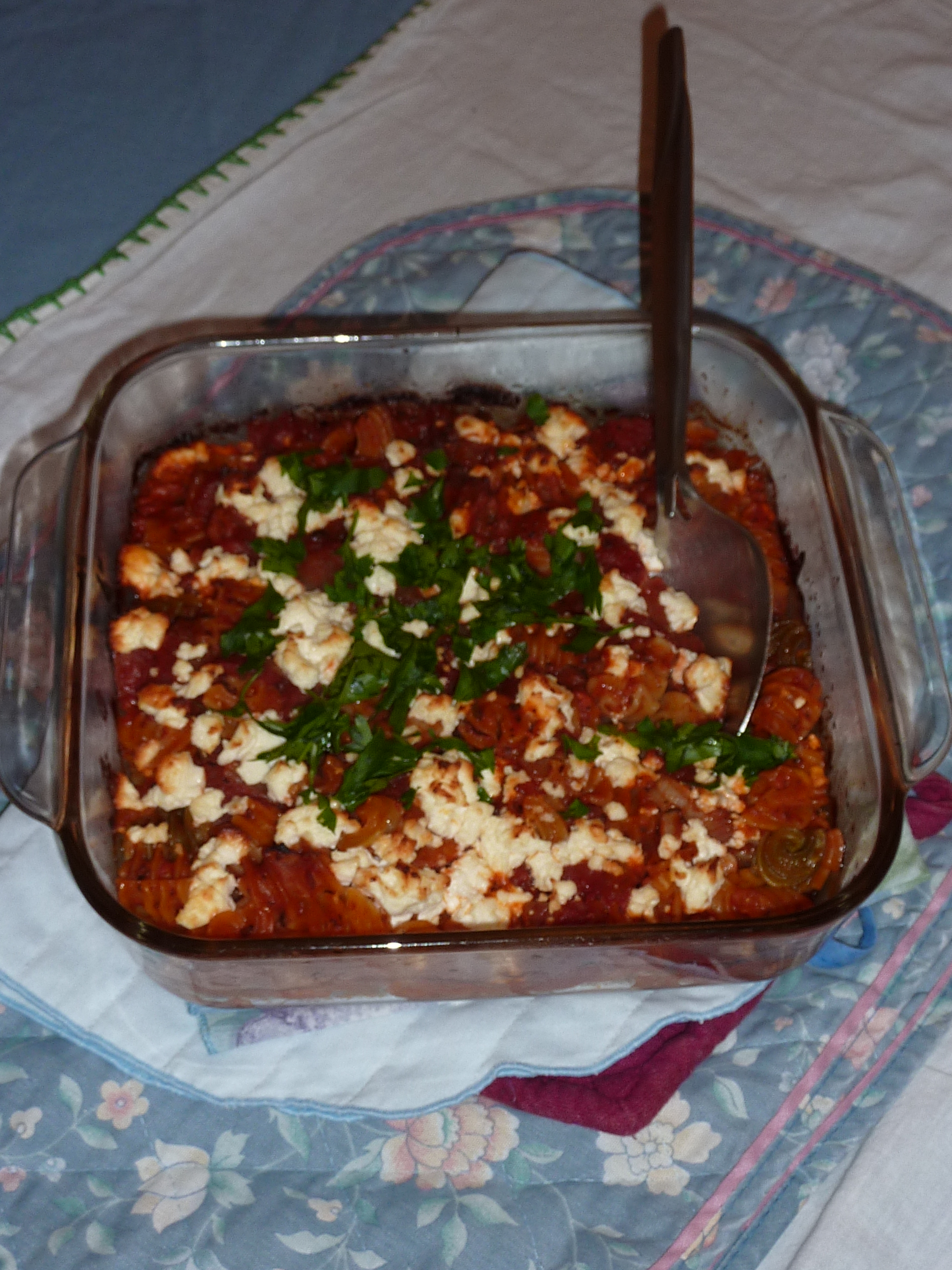
GARIDES SAGANAKI, Shrimp baked with feta and tomatoes

Photograph courtesy of Barbara Stone.
"How simple and frugal a thing is happiness: a glass of wine, a roast chestnut, a wretched little brazier, the sound of the sea. All that is required to feel that here and now is happiness, is a simple heart." Nikos KazantzakisZorba the Greek

Ah, well . . . We can't hear the sea from my little apartment. We can catch its scent though in the plump, sweet shrimp I got on sale at Whole Foods. That's the only time I buy shrimp - if at all - when it's on sale. Sweet coral-colored shrimp, deep red tomatoes, and salty white feta. What could be better than this classic Greek dish, garides saganaki, a glass of cool white wine for my guest, some briny black olives, a simple salad, and a simple heart? Happiness. Heaven.

GARIDES SAGANAKI, Wheat-and-Gluten Free
This recipe
Serves 2-3 people
  • 3 tablespoons olive oil
  • 1 medium yellow onion, rough chop
  • 2 cloves garlic, minced
  • 1 pound of medium-to-large sized shrimp, shell and devein, rinse and pat dry
  • 1/4 cup brandy
  • 1/4 cup white wine
  • 14 oz. can crushed tomatoes
  • 1 teaspoon tomato paste
  • 1/2 teaspoon dry oregano
  • Pinch of red pepper flakes
  • 3/4 box of gluten-free pasta shells
  • 3/4 pound of feta, crumble
  • 1/4 fresh Italian parsley, minced
Brown the onions in the oil in the bottom of a Dutch oven. Add the garlic when the onions are almost ready and then add the shrimp. Stir to the shrimp begins to turn color and is almost cooked through. Pour on the brandy - carefully - light it and burn it off. Remove the shrimp from the pan and set it aside.

Add the crushed tomatoes, the tomato paste, white wine, the oregano, and red pepper flakes to the pan and stir to mix well.  Allow to simmer and thicken for about 25 minutes.

Preheat the oven to 425° while the sauce is thickening. Prepare the pasta al dente and drain. Set aside. You can mix it with a bit of olive oil to keep it from sticking together.

When the sauce is ready, spoon some into the bottom of a 8" x 8" baking pan. Mix the shrimp and past and place the mixture in the pan. Top with the sauce and then the feta and sprinkle with the minced parsley.

Bake for 25 minutes until it is heated through. Allow to sit for five minutes or so before serving.

Actual product ingredients may differ from than that which is shown or suggested on this blog. Please remember that you should not rely solely on the information presented here or anywhere online and that you always read labels, warnings, and directions before purchasing and consuming a product.