Showing posts with label Greek food. Show all posts

Tuesday, October 5, 2010

POMEGRANATES, Starting to show up in stores and national pomegranate month coming up

375px-Illustration_Punica_granatum2
Illustration from Prof. Dr. Otto Wilhelm Thomé Flora von Deutschland, Österreich und der Schweiz, 1885, Gera, Germany courtesy of Wikipedia.
When we eat pomegranates, we eat food fit for a goddess. In Greek mythology Persephone, daughter of Zeus and Demeter, was abducted and taken to the underworld by Hades. Zeus demanded that she be returned to earth. Hades had to relent, but Persephone ate four pomegranate seeds and for that she was doomed to return to the underworld for several months (winter time when fields and trees are dormant) each year. 
We, on the other hand, eat pomegranates and are "doomed" to good health. High in antioxidants and ellagic acid, they are believed to mitigate cardiovascular disease, high blood pressure, and potential for various cancers including breast and prostate. Pomegrantes are, however, contraindicated for those taking certain medications.  So, if you are on cholesterol lowering or blood pressure lowering medications, it's best to check with your doctor or pharmacist before indulging.
Persians put out big bowls of pomegranates at weddings for fortunate and fruitful marriages. In Persian (Iranian) cuisine - a largely undiscovered wonder in the U.S. - it is used in many delicious ways including their tantalizing walnut, bell pepper, and pomegranate dip, muhamarra.  It's quite easy to prepare: In a blender combine
  • two large red peppers, seeded and cut in chunks
  • 1/2 cups of raw walnuts
  • 3 teaspoons of fresh pomegranate juice
  • 2 cloves of garlic
  • 1 1/2 tablespoons of lemon juice
  • 1/2 teaspoon ground cumin
  • 1/8 teaspoon of Aleppo pepper
  • sea salt to taste
  • 1 1/2 tablespoons extra virgin olive oil, best quality you can afford
Blend well.  Taste and adjust salt, lemon and olive oil and give it another whirl in the blender.  Pour into a bowl and serve with crudités.  (Great dish for raw foodists.)

Among modern-day Greeks on New Year's Day, pomegranates are taken outside the house and smashed on the ground to disperse the seeds for good luck. The further the seeds travel, the better the luck. More practically speaking, the pomegranates are used in drinks, salad dressings, fruit salads, and just by itself. To get at the seeds, cut the pomegranate in half.  Hold the halves over a bowl of cold water and tap the shell.  The seed and the pith will fall into the water. The seeds will float to the bottom and the pith to the top, making it easy to separate them.  Drain off the water and pith and eat the whole seed.  The flavor is in the juicy outer part, but the fiber is in the inner kernel, so eat the whole thing for maximum delight and health benefit.
ME014
Pomegranate molasses can be combined with the seeds and juice of the fruit to make a delicious Greek salad:
  • 1/2 cup pomegranate juice
  • 2 tablespoons pomegranate molasses
  • 3 tablespoons extra virgin olive oil, best you can afford
  • 2 teaspoons Annie's Dijon mustard (gluten-free)
  • Freshly ground sea salt, to taste
  • Freshly ground black pepper, to taste
  • 10 cups of mesclun salad mix
  • 1 apple, thinly sliced
  • 1/2 cup of crumbled feta
  • 1 cup of pomegranate seeds
For the vinaigrette, combine the juice, molasses, oil, salt and pepper in a bowl and whisk.  To make the salad, combine the greens and the apple in a large mixing bowl. Drizzle with half of the vinaigrette and mix.  Divide the dressed greens among eight salad dishes. Top with the crumbled feta and the pomegranate seeds.  Spoon some more of the vinaigrette over each portion, and you're ready to go.
In Lebanese cuisine pomegranate seeds are sprinkled on bowls of leban (yogurt) and on hummus bi tahinichickpeas with sesame seed paste, and baba ghanouz, tahini with eggplant. There is also a popular pomegrante drink - Americans would call it a "mocktail."  Combine the following ingredients in a pitcher and serve over ice:
  • 2 1/2 cups fresh pomegranate juice
  • 1/2 cup fresh-squeezed lemon juice, Meyers preferred when you can get them
  • 1 teaspoon orange-blossom water*
  • honey or sugar to taste
  • 4 cups mineral water
20846-orange-blossom-water
* Orange blossom water and rose-water are used frequently in Middle Eastern cooking.  It may be a bit of an acquired taste.  Hard for me to tell since I grew up with it.  However, we can give you a good budget tip.  If you have a Mediterranean or Indian grocer near you, these waters will be half or even one-third the price of the same product in other stores.  And, a beauty tip: rose-water makes a great and very soothing toner for mature skin.


For the holidays, drop a few pomegranate seeds in glasses of champagne for the grown-ups and sparkling apple juice for the kids and watch with delight as the lovely garnet gems dance.  Or for the kids a soda with grenadine. Grenadine is a sweet syrup made from pomegranates and something with which most people are familiar since it is often used in mixed drinks. Most of  my generation got introduced to it as kids in Shirley Temple and Roy Rodger drinks, ginger ale and grenadine on ice.  They might be fun drinks for your kids during holiday season, but probably need to be renamed.  Maybe Hanna Montana and Spider Man, or something like that.

Enjoy fresh pomegranate now. The season will pass quickly.

Wednesday, September 29, 2010

YOUVARLAKIA, Greek "porcupines" in egg and lemon sauce

Pamphaios, potter Wikipedia

Lamb meatballs made with rice, simmered in chicken broth, and served in an egg and lemon sauce (avgolemono) is wonderful peasant food that can be served for any occasion. A little salad with feta to go with it - and a Lebanese or Turkish Coffee after - makes quite a heavenly little feast.  It's not too expensive.  The rice helps stretch the meat.

"Porcupines" in Lemon Sauce, Youvarlakia, (Wheat-and-Gluten Free)
The recipe
Serves four
Prepare the meatballs:
Prepare the sauce:
  • 2 cups of homemade gluten-free chicken broth or 1 sixteen-ounce package of Imagine Organic Free Range Chicken Broth, gluten-free
  • 5 tablespoons European butter, room temperature
  • 3 large omega-3 range-free eggs, at room temperature and separate
  • 2 tablespoons lemon juice, from Meyer lemons if you can get them
Combine the first eleven ingredients, which are listed under "prepare the meatballs" above. Keep working the mixture until it is like paste, then form into small balls just a bit larger than a ping-pong ball.  Roll the meatballs in the flour
Bring the broth to a boil in a large soup pot and add the meatballs, carefully one-by-one.  Break up the butter into small pieces with your hands and distribute it over the meatballs.  Cover the pot. Turn down the heat to simmer and let the meatballs cook for forty-five minutes.
Turn off the heat.  Separate out one cup of the broth.
Meanwhile, beat the egg yolks and then whip the egg whites with some salt until they are fluffy but not quite stiff. Slowly add the yolks and then the lemon juice. Continue whipping. (I do this by hand.)  Finally, slowly add the cup of broth that you set aside.
Pour the sauce over the meatballs.  Do not stir or the meatballs will break.  Do not cover the pot.  The sauce will curdle.  Just slowly shake the pot to incorporate the sauce with the meatballs.

Actual product ingredients may contain more and different information than that which is shown or suggested on this blog. Please remember that you should not rely solely on the information presented here or anywhere online and that you always read labels, warnings, and directions before purchasing and consuming a product. 

Wednesday, September 22, 2010

SKORTHALIA, Greek potato sauce/dip with garlic

This is a delicious and simple Greek sauce that is traditionally used to top fried fish or as a dip with bread. It can be used to good effect as a topping for almost any steamed vegetable.  The texture should be creamy, smooth, and somewhat thick.  It is most easily made in a food processor; but, you can mash the potatoes by hand and do the garlic with a mortar and pestle, the old fashioned way.

The recipe:

  • 6 large cloves of garlic, mashed or minced
  • 1 1/2 pounds boiling potatoes, peeled, quartered, boiled and mashed
  • 1/2 cup half-and-half or unsweetened wheat-and-gluten free soy creamer
  • 1/2 cup dry white wine
  • 1/2 cup extra virgin olive oil, the best quality you can afford
  • salt to taste
Prepare the sauce:

Put the potatoes, garlic, and creamer in the food processor and puree.  Then slowly add the oil and the wine, alternating a little of each until it's all incorporated.

Serve as dip:

Place in a small bowl on a large platter surrounded by crudités and/or gluten-free crackers or toast triangles.

Serve as sauce:

Top your choice of steamed vegetables with the sauce.  Thin if you need to with water or milk.  Or, use as a topping on pan fried or batter fired fish or batter-fried vegetables.

Actual product ingredients may contain more and different information than that which is shown or suggested on this blog. Please remember that you should not rely solely on the information presented here or anywhere online and that you always read labels, warnings, and directions before purchasing and consuming a product. 

Monday, September 20, 2010

GREEK TEA AND A GREEK SPINACH PILAF

442px-matricaria_february_2008-1
Chamomile Flowers via Wikipedia
under GNU Free Documentation License
Camomile Tea
Preparation:
Bring hot water to a roiling boil. Water should be at 183 degrees fahrenheit for tea. Pour some of the water into your teapot and swirl to warm the pot. Place one heaping teaspoon of  dried camomile per cup into your teapot. Add boiling water.  Put the cover on the pot and allow to steep for about five minutes.  Sweeten with Greek Honey.


Gluten-free Spinach Pilaf, Spanakorizo
The recipe:
Serves two as a main dish
1 pound of spinach
1/4 cup of extra-virgin olive oil
1 tablespoon fresh, sweet butter
1 medium onion, peeled and sliced thin
1/4 cup of Lundberg Brown Jasmine Rice
1 tablespoon tomato paste (in a pinch use a quality, gluten-free ketchup*
1/2 teaspoon sea salt
1/2 teaspoon cracked black pepper
1/4 teaspoon dried dill
1/4 teaspoon dried mint
1/2 cup feta cheese

Put the spinach in a drainer and rinse it thoroughly several times with cold water.
Put the olive oil and butter in a pan that is large enough to hold the spinach.  Over a low heat slowly brown the onions. When they begin to get golden, add the spinach. Cover the pan and cook until the spinach wilts, which will take about five minutes. Add the rice, tomato paste, the seasonings, and 3/4 cup of water. Stir well, bring to a boil, cover the pan and lower the heat.  Simmer for about one-half hour or until the rice is tender.  Serve hot with crumbled feta on top.

*"Organicville's Ketchup is USDA certified organic, gluten free, dairy free, vegan, and contains no added sugar. With less sodium than other brands, our ketchup is fat and cholesterol free, and is also an excellent source of lycopene. Organic ketchups have higher levels of lycopene and anti-oxidant activities than other brands tested." OrganicVille A definate thumbs-up on this one.

Whole Foods' brand ketchup is also a good gluten-free ketchup. However, it is not produced in a dedicated plant.

Dedicated facility: one that produces only wheat-and-gluten free products, thus eliminating the potential for cross contamination.

Actual product ingredients may differ from than that which is shown or suggested on this blog. Please remember that you should not rely solely on the information presented here or anywhere online and that you always read labels, warnings, and directions before purchasing and consuming a product. 

Monday, September 13, 2010

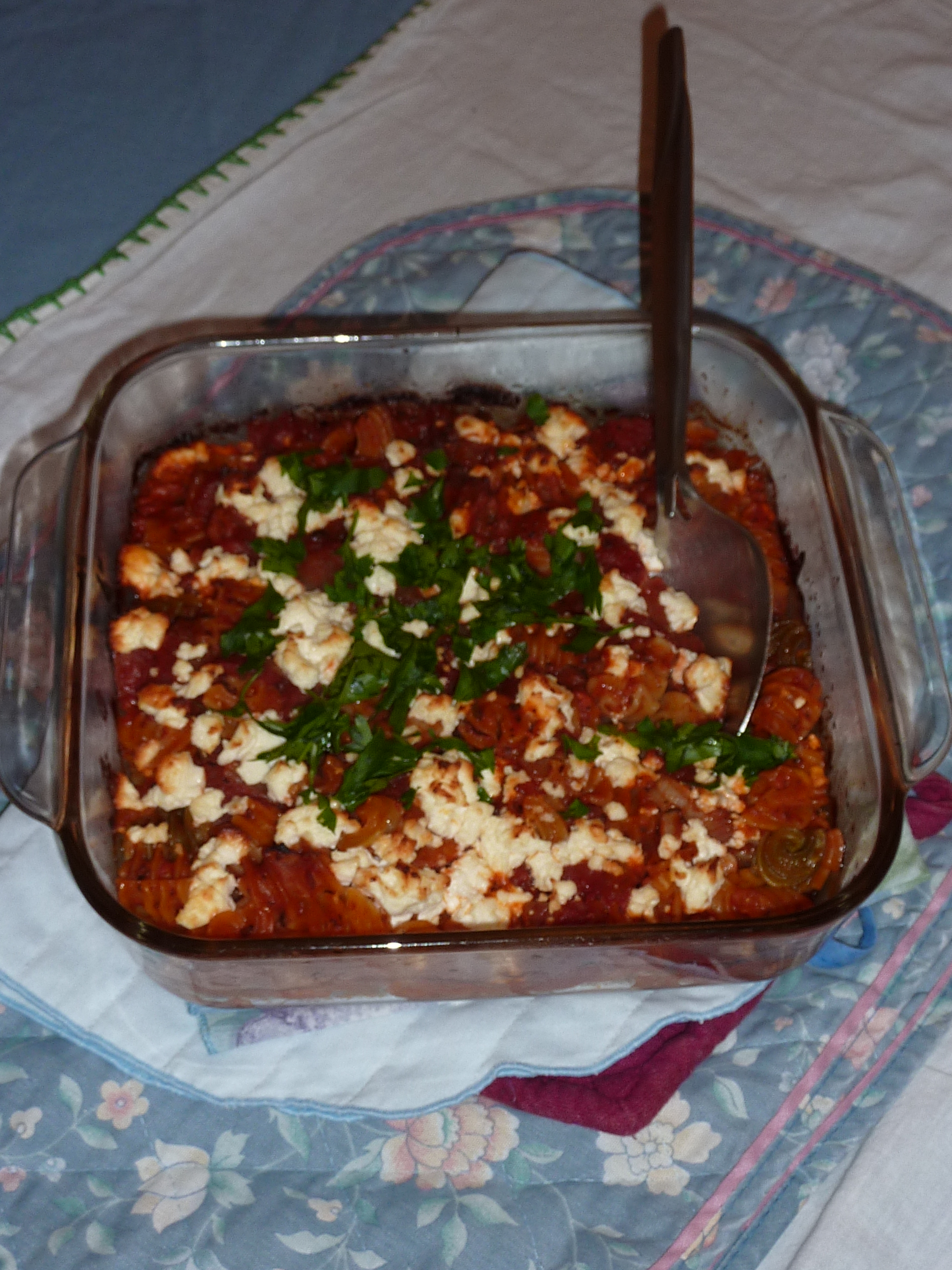
GARIDES SAGANAKI, Shrimp baked with feta and tomatoes

Photograph courtesy of Barbara Stone.
"How simple and frugal a thing is happiness: a glass of wine, a roast chestnut, a wretched little brazier, the sound of the sea. All that is required to feel that here and now is happiness, is a simple heart." Nikos KazantzakisZorba the Greek

Ah, well . . . We can't hear the sea from my little apartment. We can catch its scent though in the plump, sweet shrimp I got on sale at Whole Foods. That's the only time I buy shrimp - if at all - when it's on sale. Sweet coral-colored shrimp, deep red tomatoes, and salty white feta. What could be better than this classic Greek dish, garides saganaki, a glass of cool white wine for my guest, some briny black olives, a simple salad, and a simple heart? Happiness. Heaven.

GARIDES SAGANAKI, Wheat-and-Gluten Free
This recipe
Serves 2-3 people
  • 3 tablespoons olive oil
  • 1 medium yellow onion, rough chop
  • 2 cloves garlic, minced
  • 1 pound of medium-to-large sized shrimp, shell and devein, rinse and pat dry
  • 1/4 cup brandy
  • 1/4 cup white wine
  • 14 oz. can crushed tomatoes
  • 1 teaspoon tomato paste
  • 1/2 teaspoon dry oregano
  • Pinch of red pepper flakes
  • 3/4 box of gluten-free pasta shells
  • 3/4 pound of feta, crumble
  • 1/4 fresh Italian parsley, minced
Brown the onions in the oil in the bottom of a Dutch oven. Add the garlic when the onions are almost ready and then add the shrimp. Stir to the shrimp begins to turn color and is almost cooked through. Pour on the brandy - carefully - light it and burn it off. Remove the shrimp from the pan and set it aside.

Add the crushed tomatoes, the tomato paste, white wine, the oregano, and red pepper flakes to the pan and stir to mix well.  Allow to simmer and thicken for about 25 minutes.

Preheat the oven to 425° while the sauce is thickening. Prepare the pasta al dente and drain. Set aside. You can mix it with a bit of olive oil to keep it from sticking together.

When the sauce is ready, spoon some into the bottom of a 8" x 8" baking pan. Mix the shrimp and past and place the mixture in the pan. Top with the sauce and then the feta and sprinkle with the minced parsley.

Bake for 25 minutes until it is heated through. Allow to sit for five minutes or so before serving.

Actual product ingredients may differ from than that which is shown or suggested on this blog. Please remember that you should not rely solely on the information presented here or anywhere online and that you always read labels, warnings, and directions before purchasing and consuming a product.