Showing posts with label Book Review. Show all posts

Thursday, October 14, 2010

EMPOWERING CELIAC DISEASE PATIENTS TO GET HEALTHY

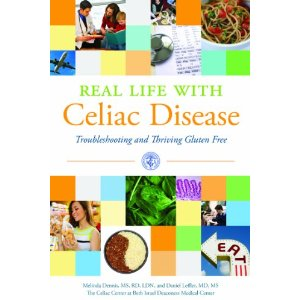
Copyrighted illustration, AGA Press
Are you among the millions with undiagnosed celiac disease or a gluten-related ailment? If you have unexplained depression, anemia, infertility, bone degeneration, liver diseasevitamin deficiency, or trouble with your balanceReal Life with Celiac Disease will help you consider whether you have undiagnosed celiac disease and need to go gluten-free.
It you have been diagnosed with celiac disease or gluten sensitivity. Find out:
  • Why you still have symptoms, even though you're eating gluten free
  • Easy ways to adjust to a gluten-free lifestyle
  • How to heal your gut with gluten-free fiber vitamins, minerals, probiotics, and more
  • Where to look for hidden gluten and why cheating has serious consequences
  • Whether you can eat oats and what starch and how to travel and dine out safely
  • How to eat healthy if you are a vegetarian, have diabetes, or want to lose weight
  • Which family members need to be tested for celiac disease
  • How celiac disease should be monitored by your health care team throughout life
Real Life with Celiac Disease, Troubleshooting and Thriving Gluten Free by Melinda Dennis, M.S., R.D., LDN and Daniel A. Leffler, M.D., M.S.
I received this book to review from the American Gastroenterological Association (AGA). If I saw this on a shelf in a bookstore, it's likely I wouldn't have bought it. I've been dealing with celiac disease with fair success for a number of years now. I don't think I know it all, but after a while it all gets old. I have my cooking and dietary policies established and just want to move on with life.  Nonetheless, I find  I'm glad I received a review copy. I couldn't put it down.
The book offers a chapter-by-chapter overview and update on all facets of celiac disease, each one written by a professional in that specific area. In textbook fashion, chapters end with suggested further reading. The book offers comprehensive, up-to-date, and practical information and guidance on a broad range of celiac disease and gluten-related disorders and issues.
The  many values of Real Life with Celiac Disease include:
  • up-to-date discussions of celiac conditions other than just the standard discussions of gastrointestinal issues, vitamin deficiency, and skin disease (dermatitis herpetiformis), including depression, liver disease, anemia, and osteoporosis
  • clarification of the connections or lack there-of between celiac disease and various cancers, including breast cancer
  • guidelines for successfully combining both vegetarian and diabetic diets with a gluten-free diet
  • malabsorption of fructose, lactose, and related carbohydrates
  • information on how your medical team should be monitoring your celiac disease
  • guidance for reading food-labeling in Canada and the United States
  • dealing with celiac disease when you have an eating disorder
  • comprehensive information on successfully accommodating lifestyles
  • information on infant feeding and celiac disease
Until the 1990s, we believed that celiac disease was unavoidable if the person had inherited the genetic risk from a parent. Then, between 1984 and 1996, Sweden experienced an epidemic of celiac disease in children under two years of age. Diagnosis of celiac disease rose to levels higher than found in any other country and then sharply declined back to the previous level. Clearly genetics isn't the only thing that determines the development of celiac disease; environment and lifestyle are important aspects, too.
Real Life with Celiac Disease devotes a chapter to the changing diet of humans over the millenia, how celiac disease has evolved, why it is still often not recognized by physicians as anything more than a childhood disease, and why and how we have moved from incidence of celiac disease to prevalence.
One of the chapters I most appreciate is the chapter on combining a gluten-free diet with a vegetarian diet. Before I found I had celiac disease I was virtually vegan. My concessions to an animal-based diet were cream in my coffee and plain, nonfat Greek yogurt. I was discouraged from continuing that diet. Now I feel empowered to revisit that option and reevaluate.
I must say, I was ready to take a week or so to read the book in between doing other things, but that is not the case at all. Once started, I had to pursue it to the end. I found it to be clear, engaging, and recommend it as good choice for either an introduction to celiac disease or an update. It's comprehensive and organized in a way that will save you a lot of research time.

Monday, September 13, 2010

NATIONAL CELIAC AWARENESS DAY, this may save your life ...

Samuel Jones Gee, born September 13, 1839.
Samuel Jones Gee (13 September 1839 – 3 August 1911) was an English physician. In 1888, Gee published the first complete modern description of the clinical picture of coeliac disease [Celiac Disease], and theorised on the importance of diet in its control. His contribution led to the eponym Gee's disease. Gee is also credited with the first English-language description of cyclic vomiting syndromeMORE[Wikipedia]
September 13, Dr. Samuel Gee's birthday, is the date of U.S. National Celiac Awareness Day (S. Res. 563, 2006). Gee was the first to find the link between celiac/sprue and diet.


Pressed for time, I apologize for writing this from a mostly American perspective. Celiac disease is a universal health issue, not restricted to any specific peoples or place.  In this country and elsewhere it goes largely unrecognized and undiagnosed with devastating results. It is thought that 95% of the people who have Celiac disease have a genetic disposition to it. The thing is that most of us don't have parents who were ever tested or diagnosed.  My mother, who battled cancer from the age of thirty-six on, probably had it.  She had radiation treatments while pregnant with me and died painfully at seventy-six of colon and breast cancer. Celiac disease may have been the primary cause of her multiple cancers. We'll never know. I have it. My son was tested after my diagnosis. He tested negative.


The percentages are small, but the numbers are significant: people with conditions such as lupus, cancer, autoimmune disease, osteoporosis, diabetes, irritable bowel syndrome, attention deficit, autism ... and the list goes on and on ... actually have Celiac disease as the primary condition from which the other results.
[Undiagnosed and unaddressed allergy or sensitivity to wheat, barley, rye, kamut, and spelt] is the root cause of many cancers, autoimmune diseases, neurological diseases, chronic pain syndromes, psychiatric and other brain disorders, premature death. There is also a clear causal connection with some cases of osteoporosis, epilepsy, attention deficit disorders and learning disorders, infertility, miscarriage, premature births, chronic liver disease, and short stature." Dangerous Grains
In my case, hypersensitivity pneumonitis and lung fibrosis were exacerbated by Celiac Disease and, when I went on a wheat-and-gluten-free diet, my condition improved enough that I was pulled off the lung transplant list. I had a sixteen percent increase in diffusion of gases, oxygen and carbon dioxide, a critical measure of lung function. Although a transplant is still a probability, I have bought myself time, comfort, and a better quality of life.  In the five years since I discovered my allergy, thanks to the efforts of many dedicated people including these two authors, I have seen Celiac awareness grow and the numbers of wheat-and-gluten free products that are easily available has increased substantially.


This is some of what you will learn if you read Dangerous Grains:
In Dangerous Grains, Dr. Braly and Mr. Hoggan explain the symptoms, the diagnostic tools, the risk factors, and the treatment, which is a life-style change. You may not eat any of the verboten foods which include: wheat, barley, rye, or oats, unless the oats are certified to be gluten-free. (Oats are naturally gluten-free but become contaminated through crop rotations.) This means no breads, breakfast cereals, or pastas made with dangerous grains. If you are a beer drinker, you must make sure the beer is gluten-free.  Before you buy, you must check ingredient lists on every product to make sure there is no hidden wheat or gluten.


The gluten-free lifestyle offers value added.
There are at least two major ancillary benefits to following a gluten-free diet.
  • You can no longer rely on prefabricated foods with all their chemical additives. As a result, you end up eating more fresh produce, because such foods are naturally gluten-free.
  • This dietary change may decrease your intake of Omega 6, which is higher than it should be in the Standard American Diet (SAD).
Getting diagnosed.
One of the ways to diagnose Celiac is a simple blood test. Ask your doctor about these:
  • Anti-tissue transglutaminase (tTg-IgA) - the most common and most sensitive blood test, which is used even when patients are asymptomatic.
  • Anti-endomysial antibody (EMA-IgA) - not as sensitive as the first test, but often used specifically for Celiac Diseases.
  • Total Serum IgA- often used to check the IgA levels, it excludes selective IgA deficiencies that result from false-negative test.
I believe we would make real progress if a blood test was automatically performed when anyone is diagnosed with one of the more than two-hundred chronic or catastrophic diseases that can result from Celiac, even if only to rule it out.  I don't know why this isn't done, but that doesn't prevent requesting the test for yourself and your children.  Insurance generally will pay.  If it doesn't, the test is not that expensive.  Disease is. Something of note that was covered in Dangerous Grains:  In Italy, with parent's permission, children are automatically tested at age six before they start first grade. That makes good sense to me considering the possible connection to attention deficit.


My experience was unusual: In an effort to drop  a few pounds, I went about two weeks eating salads and fruit and so forth and no grains. I was still able to work then.  I was feeling really, really good - way better than I normally did - and came home one night and decided to treat myself to pasta along with my salad. I became quite ill. I felt it was connected to dinner.  All my food was fresh. I didn't think I was reacting to the veggies, homemade dressing, or homemade ragu. I decided it had to be the pasta and researched it. I've been on a wheat-free diet since then. By the time I had a blood tests and a stomach biopsy, I'd been off of wheat for more than six weeks, so we were unable to confirm.  However, since there was no other way to account for my improved lung function numbers, my doctors are in agreement that wheat and gluten are issues for me. One way many people test is to go wheat-free for six weeks and then go back to wheat and see what happens. It worked for me.


Recommended sources of information and products:
Living Without Magazine
and
Living Gluten-Free for Dummies by Donna Korn
Both these resources are particularly helpful if you are raising children who have food allergies. In the U.S., Whole Foods is one of your best bets for wheat-and-gluten-free products. This national grocery chain has a commitment to serving people with special diets. Trader Joe's is also a good resource. For gluten-free shopping, glutenScan, an iTunes app powered by Zeer, may be helpful especially for beginners. Despite the iPoem post I wrote yesterday, I don't have an iPhone so I can't provide personal testimony. I took creative license.


Eating out gluten-free.
Restaurant eating is a challenge, but not an insurmountable one. It takes some thought, planning, and assertiveness to make eating out work. You may find that you have to make a meal of side dishes and salads to accomplish your aim. Chinese and other Asian restaurants use soy sauce that is wheat based; so, if you find you have this sensitivity or allergy, you must cross them off your list.  You can prepare Chinese food at home using wheat free tamari. In the U.S., P F Chang's is the only Chinese restaurant that I know of that offers and gluten-free menu.


In sum:
If you or anyone in your family is dealing with a chronic illness or condition or even a catastrophic one, I urge you to look into Celiac DiseaseDangerous Grains is among the best of the primers.  The effort is well worth the time, even if all you are doing is ruling out Celiac Disease or wheat-and-gluten sensitivity.


Notes:
Gluten: A pair of proteins that trigger a toxic reaction by the autoimmune system in people who have Celiac Disease or wheat and gluten sensitivity.